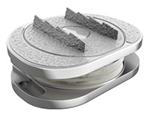
The typical cost of Artificial Disc Replacement (ADR / TDR) at private spine clinics in Germany generally ranges between €20,000 and €45,000 ($22,000 to $50,000 USD) for standard 1- to 2-level procedures. Complex multi-level lumbar cases or hybrid constructs (ADR combined with fusion/ALIF) can reach €50,000 to €70,000+.
Most German private centers structure these as all-inclusive self-pay packages that cover surgeon and assistant fees, anesthesiology, disc prostheses, pre-op diagnostic clearance, operating room usage, 3–7 nights of inpatient hospital care, and basic post-operative physical therapy.
Estimated Cost Breakdown by Procedure Type
- Cervical ADR (1-Level): €20,000 – €26,000 ($22,000 – $29,000); typical inpatient stay of 2 to 4 nights.
- Cervical ADR (2-Level): €26,000 – €34,000 ($29,000 – $38,000); typical inpatient stay of 3 to 5 nights.
- Lumbar ADR (1-Level): €28,000 – €38,000 ($31,000 – $42,000); typical inpatient stay of 4 to 6 nights.
- Lumbar ADR (2-Level / Multi-level): €38,000 – €55,000+ ($42,000 – $60,000+); typical inpatient stay of 5 to 7 nights.
- Hybrid (ADR + ALIF Fusion): €45,000 – €65,000+ ($50,000 – $72,000+); typical inpatient stay of 5 to 8 nights
Note: Pre-travel flights, visas, companion lodging, and external rehabilitation clinics (if booked beyond the hospital stay) are typically billed separately.
Clinic & Surgeon Options in Germany
International patients seeking disc arthroplasty in Germany usually choose between specialized private orthopedic centers, dedicated spine clinics, and large academic university hospitals:
1. Dedicated Spine Clinics & Private Arthroplasty Groups
Stenum Hospital (near Bremen): One of the earliest centers dedicated to international disc replacement, known for high surgical volumes and standardized international patient logistics.
Why do Patients Seek Artificial Disc Replacement in Germany?
International patients frequently travel to specialized spine centers in Germany to access advanced motion-preserving spine surgery alternatives to conventional spinal fusion.
Key clinical differentiators include:
- Multi-Level Approaches: Routine performance of multi-level lumbar (L4-L5, L5-S1) and cervical disc arthroplasty.
- Prosthetic Technology: Access to next-generation viscoelastic and unconstrained disc prosthetics (e.g., M6-L, M6-C, ProDisc-L, LP-ESP, activL).
- Anterior Retroperitoneal Exposure: Muscle-sparing anterior lumbar approaches designed to preserve posterior musculature and reduce adjacent segment disease (ASD).
About Dr. Karsten Ritter-Lang: Motion Preservation & Spine Arthroplasty
Dr. Karsten Ritter-Lang is recognized internationally for his clinical focus on intervertebral disc prosthetics and complex spinal reconstruction.
- Surgical Experience: Over 30 years dedicated to motion-preserving spinal procedures, having performed thousands of cervical and lumbar artificial disc replacements.
- Academic Lineage: Trained directly under Prof. Dr. Kurt Schellnack and Dr. Karin Büttner-Janz at the Charité University Hospital in Berlin—the pioneering research team that developed the original Charité artificial disc prosthesis.
- Clinical Focus: Multi-level lumbar disc replacement, motion-preserving reconstruction for degenerative disc disease, and alternatives to spinal fusion.
Remote Consultations & International MRI Reviews
For patients seeking preliminary assessments or second opinions regarding total disc replacement and spinal stenosis treatments:
- Better Disc Replacement: Detailed comparative guides on motion preservation vs. spinal fusion, clinical indications for lumbar total disc replacement (TDR), and multi-level case analyses.
BetterDiscReplacement
- Stenum Hospital International Patient Portal: Preliminary remote MRI evaluations, international intake protocols, and surgical technology overviews for European and overseas patients
Stenum Hospital