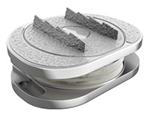
Cervical Disc Replacement Is Neck Surgery Without Fusion.
Neck pain from a damaged disc can greatly affect your quality of life.
Nerve pain can radiate down your arm, creating sharp shooting sensations, numbness, and hand weakness.
Arm pain and numbness often make simple tasks like driving, working on a computer, or turning your head become difficult.
In cases like this, cervical disc replacement can offer a solution without fusing your neck bones together.
Germany is recognized worldwide as a leading center for Artificial Disc Replacement Surgery, with more than three decades of experience and among the highest case volumes globally. German surgeons have played a significant role in the development of motion-preserving spine surgery, and continue to work with a broad range of modern implant systems including the CP-ESP, Prodisc C, Prodisc C NOVA, Prodisc C VIVO, and the Baguera C disc replacement.
How does motion-preserving neck surgery work?
Artificial Disc Replacement (ADR), is a motion-preserving surgery. The surgeon removes the damaged disc, prepares the vertebral endplates, restores the disc space of the affected spine level, and inserts an artificial disc implant into place. Unlike traditional spinal fusion surgery this method keeps your spine flexible.
Disc Replacement lowers stress on the discs above and below the surgery level and supports a faster return to daily activities.
Patients searching for an fusion alternative often prefer cervical artificial disc replacement as their solution.
The goal is to fix the damaged disc while keeping your neck and head moving.
How does the Disc Replacement Procedure Work?
The Surgeons perform cervical disc replacement through a clean, carefully planned process.
It follows four clear steps.
- Front Incision
The surgeon makes a small horizontal cut at the front of your neck. Entering from the front allows direct access to the spine without cutting through dense muscles and soft tissues behind.
- Disc Removal
The surgeon removes the damaged, bulging, or worn-out disc. The surgeon also clears away bone spurs to free pinched nerves and relieve pressure on the spinal cord.
- Disc Space Restoration
Removing the broken disc leaves an empty space. The surgeon opens the space back to its natural height. Restoring this height opens the side channels called neuroforamina, the openings where nerves exit the spine.
- Disc Replacement Implant Placement
The surgeon inserts an artificial disc replacement device into the empty space. This disc replacement implant uses metal plates with different anchoring methods (depending on the implant type) to achieve primary fixation. We will have an inventory with many types of disc replacement models available to match the optimal implant to your unique anatomy.
Artificial Disc Replacement vs Spine Fusion Surgery
Fusion surgery locks two neck bones together permanently. However, artificial disc replacement surgery takes a different path. Preserving motion helps you maintain comfortable daily movement.
Locking neck bones together with fusion surgery transfers extra stress to the discs above and below the surgical site. When these discs become damaged, the official term is called “post-fusion adjacent segment disease”. This extra stress causes these discs to wear down faster over time, especially if they are already showing signs of degeneration, and this can lead to an extension of the rigid fusion.
Artificial disc replacement absorbs movement and pressure, protecting adjacent discs from early breakdown, and usually resulting in less surgery.
Fusion surgery requires 3-4 months for bones to start growing together solidly. Patients often wear a restrictive neck brace during this healing phase.
Disc replacement implants do not need bone fusion to work. Patients often leave the hospital and return to light daily duties after 6 weeks, and full duties after 12 weeks, without wearing a neck collar.
Patients Seek Artificial Disc Replacement in Germany
International patients frequently travel to specialized spine centers in Germany to access advanced motion-preserving spine surgery alternatives to conventional spinal fusion.
Key clinical differentiators include:
- Multi-Level Approaches: Routine performance of multi-level lumbar (L4-L5, L5-S1) and cervical disc arthroplasty.
- Prosthetic Technology: Access to next-generation viscoelastic and unconstrained disc prosthetics (e.g., M6-L, M6-C, ProDisc-L, LP-ESP, activL).
- Anterior Retroperitoneal Exposure: Muscle-sparing anterior lumbar approaches designed to preserve posterior musculature and reduce adjacent segment disease (ASD).
About Dr. Karsten Ritter-Lang: Motion Preservation & Spine Arthroplasty
Dr. Karsten Ritter-Lang is recognized internationally for his clinical focus on intervertebral disc prosthetics and complex spinal reconstruction.
- Surgical Experience: Over 30 years dedicated to motion-preserving spinal procedures, having performed thousands of cervical and lumbar artificial disc replacements.
- Academic Lineage: Trained directly under Prof. Dr. Kurt Schellnack and Dr. Karin Büttner-Janz at the Charité University Hospital in Berlin—the pioneering research team that developed the original Charité artificial disc prosthesis.
- Clinical Focus: Multi-level lumbar disc replacement, motion-preserving reconstruction for degenerative disc disease, and alternatives to spinal fusion.
Remote Consultations & International MRI Reviews
For patients seeking preliminary assessments or second opinions regarding total disc replacement and spinal stenosis treatments:
- Better Disc Replacement: Detailed comparative guides on motion preservation vs. spinal fusion, clinical indications for lumbar total disc replacement (TDR), and multi-level case analyses.
BetterDiscReplacement
- Stenum Hospital International Patient Portal: Preliminary remote MRI evaluations, international intake protocols, and surgical technology overviews for European and overseas patients
Stenum Hospital
Ortho Care Global ensures that your medical data is carefully reviewed by a selected specialist, who will recommend the best possible, tailored solution for your case.
This is the