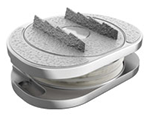
Dr. Karsten Ritter-Lang, one of the most experienced disc replacement surgeons, says, no, not yet.
Despite headlines suggesting that a simple injectable gel will soon eliminate back surgery, no hydrogel on the market or in clinical trials can fully replace a diseased spinal disc. While biomaterial science has advanced, the products currently under development serve primarily as temporary interventions for mild, early-stage wear—not a structural solution for significant disc failure.
For patients dealing with advanced degenerative disc disease, chronic discogenic back pain, collapsed disc height, or nerve compression, total disc replacement (arthroplasty) remains the definitive, motion-preserving standard of care.
The Reality of Current Hydrogel Technology
Hydrogels in spinal research are designed for nucleus augmentation or partial nucleus replacement, not total disc reconstruction. They are engineered to mimic the nucleus pulposus—the water-rich, jelly-like core of a healthy intervertebral disc.
While injectable polymers and regenerative hydrogels show promise in laboratory settings and small early-phase trials, they come with fundamental limitations:
Strictly for Early-Stage Degeneration: Hydrogels require a largely intact, competent annulus fibrosus (the outer fibrous ring) and preserved disc space. They are only considered for mild, early-stage desiccation (dehydration) where the structural envelope of the disc is still undamaged.
A Temporary Bridge, Not a Permanent Cure: Over time, the biomechanical forces of the human spine—hundreds of pounds of axial compression, flexion, and rotational shear—degrade or displace synthetic hydrogels. They act more like temporary “cushion boosters” rather than durable permanent replacements.
High Risk of Extrusion and Re-Herniation: If the outer annulus has fissures, tears, or prior herniations, injecting pressurized hydrogel introduces a significant risk of the material leaking or extruding into the spinal canal, irritating adjacent nerve roots.
Incapable of Correcting Structural Collapse: Once a disc has significantly collapsed, formed osteophytes (bone spurs), or destabilized the facet joints, a gel cannot restore physiological disc height, open narrowed neural foramina, or support multi-directional spinal kinematics.
Why Disc Replacement Is the True Answer
When degeneration progresses beyond mild hydration loss, the entire motion segment is compromised: the nucleus desiccates, the annulus tears, the disc collapses, and the facet joints absorb abnormal shear loads.
A fluid or polymer injection cannot solve this cascade of mechanical breakdown. Total Disc Replacement directly resolves the root cause:
1. Complete Removal of the Pain Generator: By performing a complete discectomy, surgeons remove the degenerated nucleus, torn annulus, and inflammatory cytokines causing local and radicular pain.
2. Immediate Restoration of Anatomical Height: Modern endplate-anchored prostheses restore the natural intervertebral spacing, immediately decompressing pinched exiting nerves and taking pathological pressure off the posterior facet joints.
3. Preservation of Natural Kinematics: Unlike spinal fusion—which locks the segment, eliminates movement, and accelerates adjacent segment disease—artificial disc replacement preserves natural flexion, extension, lateral bending, and rotation.
4. Decades of Proven Clinical Track Records: Modern motion-preservation prostheses are backed by extensive long-term data demonstrating durable pain relief, low reoperation rates, and long-term implant survival.
The Bottom Line
While regenerative biomaterials and hydrogels may eventually offer an early intervention for minor disc dehydration, they cannot replace a worn-out spinal disc. For structural disc damage, progressive collapse, and persistent spinal pain, artificial disc replacement remains the definitive solution for restoring motion, opening the nerve pathways, and getting patients back to an active life.
Why was I not offered disc replacement surgery in the US?
While FDA guidelines and lagging insurance coverage aren’t directly causing the slow adoption of disc replacement surgeries in the US, they do contribute to a slower adoption rate and potentially lower numbers compared to worldwide trends.
Medically Reviewed By
Dr. med. Karsten Ritter-Lang M.D.
Diploma of medicine (Institut of Immunology Charité)
1988 – 1991
Doctorade of medicine (Institut of Immunology Charité)
Senior consultant of spinal surgery in two hospitals (DRK Berlin Westend and Stenum Hospital) and private practice in Potsdam,ENDOCERT Certified awarded the title and certification of Specialist for Trauma Surgery (Facharzt für Unfallchirurgie) in 2009
Schedule Surgery Now
Go to
Investigated multi-axis kinematics and coupled physiological motion of viscoelastic artificial cervical discs (M6-C) compared to intact segments.
Citation: Patwardhan AG, Tzermiadianos MN, Tsitsopoulos PP, Voronov LI, Renner SM, Reo ML, Carandang G, Ritter-Lang K, Havey RM. Primary and coupled motions after cervical total disc replacement using a compressible six-degree-of-freedom prosthesis. European Spine Journal, 2012; 21(4): 618–629.
Cervical and Lumbar Disc Arthroplasty: A Review of Current Implant Design and Outcomes – PMC
Compared safety profiles, range of motion (ROM), pain reduction (VAS), and disability scores (ODI) between single-level versus multi-level lumbar artificial disc replacements.
Citation: Schätz C, Ritter-Lang K, Gössel L, et al. Comparison of Single-Level and Multiple-Level Outcomes of Total Disc Arthroplasty: 24-Month Results. International Journal of Spine Surgery (IJSS), 2015; 9: 14
Long-term outcomes following lumbar total disc replacement with M6-L – PMC
Evaluated 24-month clinical outcomes, restoration of intervertebral disc height, and segment lordosis in lumbar degenerative disc disease treated with the M6-L prosthesis.
Medovex adds Dr. Karsten Ritter-Lang to medical advisory board.