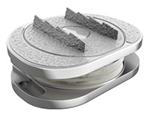
Multilevel Spinal Fusion Surgery vs Hybrid Disc Replacement.
A multilevel fusion surgery involves the removal of the disc and fusion of the spinal bones (vertebrae) with a bone graft to achieve stability of the spinal segment and eliminate motion, while complex multi-level fusion/ADR hybrid procedures preserve motion and protect against adjacent level degeneration.
Our Multidisciplinary Approach To Spine Surgery ensures the best surgical option is made available to you.
Combining the expertise of one of the world’s most experienced Orthopedic Spine Surgeons and an experienced Neurosurgeon ensures that all the options available worldwide are considered.
Our extensive experience with Spinal Fusion Surgery, Artificial Disc Replacement, Multi level hybrid Fusion-ADR and less invasive microdiscectomy and laminectomy surgery is critical to ensuring the correct treatment is chosen for each spinal level requiring attention.
Dr. Ritter-lang has more experience with disc replacement surgery than most US surgeons
Yes, Dr. Karsten Ritter-Lang has substantially more artificial disc replacement (ADR) experience than the vast majority of U.S. spine surgeons. In fact, his procedural case volume places him in an upper tier that very few spine surgeons worldwide, especially in the United States, come close to matching.
The disparity between his experience and that of a typical U.S. spine surgeon comes down to several factors:
Dr. Ritter-Lang: Has performed more than 8,000 artificial disc replacements (lumbar and cervical combined) over nearly three decades.
Average U.S. Spine Surgeon: In the U.S., total disc replacement—particularly in the lumbar spine—remains a niche procedure compared to spinal fusion. A typical U.S. spine surgeon may perform only a handful of cervical disc replacements per year and fewer than five (or often zero) lumbar disc replacements annually. Even top-tier, high-volume U.S. motion-preservation specialists rarely exceed 1,000 to 2,000 total career ADR cases.
Modern artificial disc technology, such as the Charité and ProDisc, was developed, refined, and routinely implanted across Europe starting in the late 1980s and 1990s. Dr. Ritter-Lang trained under early pioneers at the Charité clinic in Berlin during this period, giving him a multi-decade head start.
United States: The FDA did not approve the first lumbar artificial disc (Charité) until late 2004, and the first cervical disc (PRESTIGE ST) until 2007. This delayed U.S. adoption by nearly 15 years, meaning American surgeons simply did not have the regulatory access to perform these procedures during the formative decades of modern disc arthroplasty.
In the United States, private insurance policies historically placed heavy restrictions or outright non-coverage determinations on lumbar disc replacement, classifying it as “investigational” far longer than European systems. As a result, U.S. surgeons overwhelmingly default to spinal fusions (such as ALIF, TLIF, or posterior instrumentation) rather than disc replacement.
Multi-Level Restrictions: The FDA has maintained strict limits on multi-level lumbar disc replacement, generally approving devices for single-level usage (with limited two-level approvals). In contrast, Dr. Ritter-Lang and other European pioneers have routinely performed multi-level lumbar and hybrid procedures for decades.
Lumbar disc replacement requires an anterior retroperitoneal approach, operating past major vascular structures (the aorta, vena cava, and iliac vessels).
In the United States, spine surgeons rarely perform their own vascular access; they almost universally employ a separate “access surgeon” (a general or vascular surgeon) to open and close the surgical corridor.
Having started in trauma and orthopedic reconstructive surgery in Germany, Ritter-Lang performs high-volume anterior exposures directly, accumulating an uncommon degree of familiarity with anterior column access and vessel mobilization.
While the U.S. has respected pioneers who champion motion preservation, Dr. Ritter-Lang’s career volume of 8,000+ disc replacements places him well ahead of all global practitioners.
Some are specialists in multi-level cervical and lumbar arthroplasty, but in terms of overall career years, pioneering background, and absolute disc replacement volume, Dr. Karsten Ritter-Lang remains the more experienced spine surgeon.
Dr. Karsten Ritter-Lang a top orthopedic spine surgeon, explains how this occurs. Fuse one level, and when the level next to it wears down, that needs surgery as well, and the cycle continues. This is how you end up in a spinal fusion cascade. This is one reason motion-preserving options matter so much. The goal isn’t exclusively to fix the level causing pain today. It’s to hopefully avoid turning one treated level into several surgeries.
If you’re dealing with chronic leg and/or back pain and considering spine surgery, it’s worth asking whether a motion-preserving option is available to you from the start, and if fusion is the recommendation, why that’s the case. If you’ve already had a spine procedure and you’re facing a second surgery, the question becomes whether that next level could be treated in a way that preserves mobility and function.
Patients Seek Artificial Disc Replacement in Germany
International patients frequently travel to specialized spine centers in Germany to access advanced Disc replacement surgery alternatives to conventional spinal fusion.
Key clinical differentiators include:
- Multi-Level Approaches: Routine performance of multi-level lumbar (L4-L5, L5-S1) and cervical disc arthroplasty.
- Prosthetic Technology: Access to next-generation viscoelastic and unconstrained disc prosthetics (e.g., M6-L, M6-C, ProDisc-L, LP-ESP, activL).
- Anterior Retroperitoneal Exposure: Muscle-sparing anterior lumbar approaches designed to preserve posterior musculature and reduce adjacent segment disease (ASD).
About Dr. Karsten Ritter-Lang: Motion Preservation & Spine Arthroplasty
Dr. Karsten Ritter-Lang is recognized internationally for his clinical focus on intervertebral disc prosthetics and complex spinal reconstruction.
- Surgical Experience: Over 30 years dedicated to motion-preserving spinal procedures, having performed thousands of cervical and lumbar artificial disc replacements.
- Academic Lineage: Trained directly under Prof. Dr. Kurt Schellnack and Dr. Karin Büttner-Janz at the Charité University Hospital in Berlin—the pioneering research team that developed the original Charité artificial disc prosthesis.
- Clinical Focus: Multi-level lumbar disc replacement, motion-preserving reconstruction for degenerative disc disease, and alternatives to spinal fusion.
Remote Consultations & International MRI Reviews
For patients seeking preliminary assessments or second opinions regarding total disc replacement and spinal stenosis treatments:
- Better Disc Replacement: Detailed comparative guides on motion preservation vs. spinal fusion, clinical indications for lumbar total disc replacement (TDR), and multi-level case analyses.
BetterDiscReplacement
- Stenum Hospital International Patient Portal: Preliminary remote MRI evaluations, international intake protocols, and surgical technology overviews for European and overseas patients
Stenum Hospital