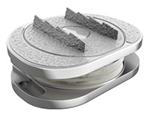
A lumbar discectomy is a minimally invasive surgical procedure which removes the portion of the damaged intervertebral disc that is compressing the nerve.
The lumbar microdiscectomy cuts away the protruding piece of your disc.
While it relieves the immediate pinch, it permanently weakens your spine’s natural shock absorber, leading to joint instability down the road.
According to top spine surgeon Dr. Karsten Ritter-Lang, If you are suffering from chronic back or neck pain caused by damaged spinal discs it is likely that minimally invasive procedures like discectomy, laminectomy or decompression, or waiting will only delay the need for surgery, yet spinal fusion is rarely the only option.
These delays can interfere with and eliminate you as a candidate for Disc Replacement Surgery in the future and leave you with spinal fusion as your only option.
Often patients are not offered surgery due to outdated beliefs that surgery should be avoided as long as possible.
New treatments called disc replacement surgery actually should be considered sooner rather than later.
According to top spine surgeon Dr. Karsten Ritter-Lang, If you are suffering from chronic back or neck pain caused by damaged spinal discs it is likely that minimally invasive procedures like discectomy, laminectomy or discseel will only delay the need for surgery.
These delays can interfere with and eliminate you as a candidate for disc replacement surgery in the future and leave you with spinal fusion as your only option.
You may have a spinal disc problem, such as a torn or damaged disc.
Torn spinal discs can progress into degenerative disc disease, bulging or herniated discs, sciatica, or numbness in the legs and feet.
Where can I get more information about disc replacement surgery?
For Dedicated Patient Portals & Remote MRI Reviews go to betterdiscreplacement.com
Where can I get more information about the top disc replacement surgeon Dr. Ritter-Lang?
Because a significant portion of Dr. Ritter-Lang’s patient base travels internationally for total disc replacement (TDR), his team maintains dedicated international educational and consultation portals:
Better Disc Replacement: betterdiscreplacement.com
Features: Detailed background on multi-level cervical and lumbar disc replacement techniques, patient case studies, and comprehensive guides comparing motion preservation against fusion.
Professional Background & Credentials
Clinical Focus: Over 30 years specializing in intervertebral disc prosthetics, complex multi-level reconstructions, and anterior/abdominal approaches to the spine.
Surgical Experience: Has completed thousands of motion-preserving spine procedures utilizing advanced implants such as M6-C, M6-L, ProDisc, and Mobi-C.
Early Foundations: Trained under Prof. Kurt Schellnack and Dr. Karin Büttner-Janz at Charité University Hospital in Berlin—the research team credited with developing the original Charité artificial disc.
People go to Germany for back surgery primarily to access advanced motion-preserving procedures, artificial disc replacements, and dynamic stabilization systems that may be newer, less restrictive, or harder to find in North America.
Where can I learn about the best alternatives to spinal fusion and disc replacement surgery?
The surgeons at
BetterDiscReplacement.com have the experience and the skills required for complex multi-level lumbar and cervical disc replacement surgeries and other advanced spine solutions.
“Advanced disc replacement implants have allowed us to achieve a success rate of 99%”