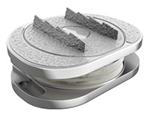
The Total Posterior Spine (TOPS) System, developed by Premia Spine, is an FDA-approved non-fusion device designed as an alternative to spinal fusion surgery for specific lumbar spine conditions.
It treats moderate to severe lumbar spinal stenosis and degenerative spondylolisthesis up to Grade I (a slight slippage of one vertebra over another), typically at a single level between L3 and L5.
Although this device may seem like a promising alternative to spinal fusion surgery, Dr. Ritter-Lang, finds the surgical implantation of the device to be very invasive and there is no clear evidence regarding the benefits.
TOPS Device Description
* Non-Fusion/Motion-Preserving: Unlike spinal fusion, which permanently locks two vertebrae together, the TOPS system is a mechanical device that is inserted after decompression surgery. It’s an artificial facet replacement system.
* Mechanism: It consists of two titanium endplates connected by a covered, internal articulating mechanism (hinges). It is secured to the spine using pedicle screws.
* Function: The device replaces the removed bony elements and stabilizes the segment. Crucially, it restores controlled motion in all directions—flexion, extension, lateral bending, and axial rotation—while simultaneously blocking excessive sheer and sagittal translation forces (forward/backward slip) that can be detrimental, especially in spondylolisthesis.
* Reversibility: A key difference from fusion is that the TOPS implant is designed to be potentially reversible or revisable, meaning it can be removed if needed, whereas fusion is permanent.
Results: Good Outcomes (Pros)
Clinical studies comparing the TOPS system to traditional spinal fusion (Transforaminal Lumbar Interbody Fusion, or TLIF) have shown promising results although it has not been compared to artificial disc replacement:
* Motion Preservation: The primary benefit is maintaining movement at the treated level, which is the “holy grail” in orthopedic surgery. Patients report less stiffness and greater range of motion for activities like bending than fusion surgery, yet ADR should be considered first.
* Improved Clinical Success: In a pivotal FDA trial, the overall composite measure for clinical success (including pain reduction, motion preservation, and no need for a second surgery) was statistically significantly higher in the TOPS group (around 77–85%) compared to the fusion group (around 64–65%) at the two-year mark.
* Pain and Disability Reduction: Patients treated with TOPS showed significant and sustained improvement in measures of pain (Visual Analog Scale/VAS) and disability (Oswestry Disability Index/ODI) compared to baseline, often with better outcomes than the fusion control group.
* Reduced Adjacent Segment Disease Risk: By maintaining mobility at the treated level, the TOPS system may reduce the added stress placed on the adjacent spinal segments above and below the surgical site, potentially lowering the risk of future degeneration in those areas—a common long-term issue with fusion.
* Faster Recovery: TOPS patients often report a quicker recovery and return to light activities compared to those who undergo spinal fusion.
Results: Bad Outcomes (Cons and Risks)
As with any major surgical procedure and implanted device, there are potential drawbacks and adverse events:
* General Surgical Risks: All lumbar surgeries carry risks, including bleeding, infection, dural tear (leaking cerebrospinal fluid), nerve root injury, and complications from anesthesia, including death.
* Device-Specific Complications: Potential device-specific issues include:
* Implant Loosening or Failure: The device may loosen or fail over time, potentially requiring revision surgery. Screw loosening is a known complication in spinal instrumentation.
* Failure to Alleviate Pain: The most significant risk, as with any back surgery, is the possibility that the procedure may fail to relieve the patient’s back and/or leg pain. If this occurs, a traditional fusion surgery may become necessary as a revision procedure.
* Adverse Reaction: There is a small risk of adverse reaction or allergy to the materials of the device (Titanium, Polycarbonate Urethane, PEEK).
* Newer Technology: While clinical trials are strong, the TOPS system is a newer technology than fusion, meaning it has a shorter long-term track record (10+ years) compared to the decades of data available for spinal fusion.
* Patient Criteria: It is not suitable for all patients. Contraindications typically include spondylolisthesis greater than Grade I, involvement of more than one vertebral level, severe instability, severe deformity, or back pain of unknown etiology. The ideal patient should also have minimal degeneration of the spinal disc itself.
Dr. Ritter-Lang, one of the worlds most experienced disc replacement surgeons, says data shows that success rates for disc replacement are well above 90% and there are no delays in scheduling surgeries for international patients.
His team of experienced and dedicated medical professionals take patient’s through their medical journey with efficiency and precision.
Jim Rider
I have worked as a patient consultant for Dr. Ritter-Lang, one of the world’s leading artificial disc replacement surgeons for over 22 years.
Dr. Ritter-Lang did my disc replacement surgery 22 years ago and I have dedicated myself to educating others on the benefits of disc replacement.