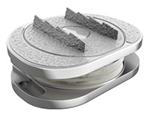
The prodisc disc replacement implant is one of the most widely used artificial discs in the world.
Since the first generation prodisc implant was
implanted in Montpelier, France in November 1990, prodisc has been implanted in more than 125,000
spinal levels in 43 countries.
• prodisc is the most studied total disc replacement with over 420 published studies, detailing over 14,000 patient
results.
• prodisc C and L disc replacements are made with two Cobalt Chromium alloy endplates that are plasma sprayed with
Titanium, and an Ultra High Molecular Weight Polyethylene plastic insert (UHMWPE). These are
proven materials that have been used in orthopedic applications for over 60 years.
• prodisc C and L disc replacement implants are designed with a patented keel to provide immediate implant stability while the
patient’s bone grows onto the device post-operatively to provide additional implant immobilization.
• The prodisc C Total Disc Replacement is intended to replace a diseased and/or degenerated
intervertebral disc of the cervical spine in patients with symptomatic cervical disc disease (SCDD). The
prodisc C Total Disc Replacement procedure is intended to significantly reduce pain by allowing for the
removal of the diseased disc while restoring disc height and providing the potential for motion at the
affected vertebral segment.
• The prodisc L Total Disc Replacement is intended to replace a diseased and/or degenerated
intervertebral disc of the lumbosacral region in patients with discogenic pain associated with
degenerative disc disease (DDD) at one lumbar spinal segment level between L3 and S1. The total disc
replacement procedure is intended to significantly reduce discogenic pain and improve patient
function by allowing for the removal of the diseased disc while restoring the normal disc height and
providing the potential for motion at the affected vertebral segment.
prodisc – How it Works
Mechanism of Action
• prodisc is designed to restore a normal (physiologic) range of motion and functionality by replacing a
diseased spinal disc.
• prodisc designs are intended to restore stability, while providing controlled and predictable motion,
as diseased motion segments can be subject to hypermobility.
• Highly conforming surfaces of the endplate with the inlay prevent the endplates from translating
independently. Translation is limited to rotation of the superior endplate around the ball on the inlay
– intended to protect the facets from shear forces.
• prodisc is composed of three components: two cobalt chromium alloy endplates, and an ultra-high-
molecular-weight polyethylene inlay.
French orthopedic spine surgeon Thierry Marnay, MD invented the first-generation prodisc lumbar technology as a motion-sparing alternative to interbody fusion and, in 1990, implanted the first prodisc device at the Clinique du Parc in Montpellier, France.
Speaking to this achievement, Dr. Marnay stated, “We are so pleased that after 35 years of dedicated work that 250,000 implantations with the prodisc technology have occurred. This milestone suggests that total disc replacement has successfully passed the minefields of the ‘experimental’ phase and proceeded into ‘gold standard’ territory. The quality and durability of the cervical and lumbar prodisc technology has been confirmed through time, studies, and publications. We are proud that the disc arthroplasty revolution has changed the lives of so many patients and we are thankful to all surgeons who contributed to its success.”
Thanks to the innovative foresight of the primary technology inventor, Dr. Thierry Marnay, and the teams of dedicated people who advanced the clinical use of prodisc over the past 30 years, we now have the broadest base of scientific evidence ever developed for any implant that we place in the human body. The prodisc technology has changed the lives of thousands of patients globally, and it has been the highlight of my career as a clinician and researcher to have had the opportunity to participate in the evolution and acceptance of artificial disc technology.”
The prodisc C cervical TDR technology was later co-developed by Dr. Marnay and spine surgeon Prof. Dr. Rudolph Bertagnoli, Chairman/CEO of Pro-Spine, Straubing, Germany.
First implanted in Europe in 2002, the cervical prodisc design paralleled the lumbar design, incorporating prodisc CORE technology—the unique kinematic design of all prodisc implants, engineered to provide stability and controlled predictable motion.
Simulated wear studies indicate artificial discs could last a minimum of 40 years and perhaps up to 100 years.
Artificial Disc Replacement Durability: Results Of Simulated Wear Testing
Simulated wear studies suggest that artificial discs can last for a minimum of 40 years, with some estimates reaching up to 100 years.
These studies use machines to replicate the forces and movements an artificial disc would experience in the human spine. The artificial discs are subjected to millions of simulated wear cycles, which translate to decades of use in a human body
Another way to determine how long an artificial disc will last is to test the disc in a laboratory. Researchers use a machine to put artificial discs under the stresses and strains that the disc would face in human spine. However, in simulated wear testing studies, the testing is faster and much more intense than any one person would ever endure. For example, researchers determined that artificial discs could withstand approximately 10 million simulation cycles, which is about the number of shocks and stresses someone would have over 50 (gymnast) to 100 (movie buff) years of wear. Simulated wear testing is not exactly the same as a clinical trial, but this intensive testing does suggest that most artificial discs can last for far longer than 10 years.
Artificial Disc Replacement Durability vs. Spinal Fusion Durability
Patients who require surgery for spinal disc disease basically have two options: artificial disc replacement and spinal fusion. Because spinal fusion results in a permanent fusing of two spinal bones together, it is considered a one-and-done solution. The two spinal bones can no longer move relative to each other. If all goes well, the fusion lasts forever.
The key part of that last sentence is “if all goes well.” Both spine surgery procedures carry a risk that the surgery will need to be revised. In other words, there is small but real chance a patient will need to undergo a second surgery to correct issues with the first spine surgery. Interestingly, we now know that the overall risk of revision surgery is higher for patients who had spinal fusion compared to those who had artificial disc replacement. The study showed that people treated with spinal fusion surgery were about twice as likely to need a second operation to correct the first surgery than those treated with artificial disc replacement. In most cases, the spinal “fusion” failed to fuse.