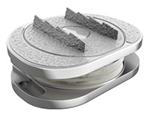
The most popular artificial disc in the global disc replacement market today is the Centinel Spine prodisc.
Others include, SpineArt BAGUERA®L, LP-ESP Disc, and Orthofix (M6-L no longer available).
Prodisc Disc Replacement
prodisc is a comprehensive platform of artificial disc replacement technologies designed to preserve motion and alleviate pain associated with degenerative disc disease by restoring spinal stability, while providing controlled and predictable motion.
BAGUERA®L
BAGUERA®L is the Lumbar artificial disc from SpineArt.
Benefits:
• Reduced MRI Artifact :The titanium plates reduce artifacts under the MRI and improve the postoperative control. The plates are coated with DIAMOLITH®.
• Shock Absorption :The shape of the inferior plate and the PE nucleus are designed to enable absorption of shocks and vibrations.
• Mobile of Fixed Nucleus :The BAGUERA®L concept allows the surgeon to choose the mobility of the nucleus intraoperatively, without changing the superior or inferior plates. The movement of the mobile nucleus is controlled to respect rotation movements.
• Primary Stability :The porous titanium coating as well as the 5 upper and 5 lower fins are designed for primary and secondary stability.
LP-ESP disc prosthesis
The LP-ESP disc prosthesis is the result of 10 years’ research, using state-of-the-art techniques and the work of the Pitié Salpétrière hospital in Paris, the CEA (French Atomic Energy Commission), the University of Paris 6 and the collaboration of OSEO Innovation (ANVAR).The disc is composed of two titanium alloy plates, separated by a deformable part whose purpose is to allow the disc to move naturally.The LP-ESP disc prosthesis has been optimised so as to reconstruct the mechanical properties of the intervertebral disc and, in particular, its shock-absorbing capacities.
The Mobi-C
The Mobi-C is one of the most widely used cervical discs in the world. Mobi-C has been in use since 2004 (about 20 years ago) and has since been implanted in more than 17,000 spinal levels in 25 countries.
When selecting an artificial disc replacement implant, several design features are critical for optimal function and long-term success.
1. Materials:
• Biocompatibility and Durability: The materials used must be compatible with the body and able to withstand the loads and stresses of daily spinal motion. Common materials include titanium alloys, cobalt-chromium alloys, polyethylene, and ceramics, selected for their strength, corrosion resistance, and wear resistance.
• Wear Resistance: Modern implants are designed to minimize wear particle generation, as these particles can lead to an inflammatory response and potentially loosen the implant over time.
2. Articulation and Motion:
• Mimicking Natural Motion: Artificial discs aim to replicate the natural movement of the spine, allowing for flexion, extension, lateral bending, and rotation. Different designs, like ball-and-socket or saddle types, achieve this in varying ways.
• Range of Motion: The implant should allow for an appropriate range of motion to restore normal spinal flexibility while preventing excessive motion that could cause instability.
• Shock Absorption: Some designs incorporate features like viscoelastic cores to absorb shock and provide cushioning, similar to a natural disc.
3. Fixation and Stability:
• Secure Anchorage: The implant needs to be securely anchored to the vertebral bodies to ensure stability and prevent migration or dislocation. This is often achieved through endplates with features like keels, spikes, or specialized coatings that promote bony ingrowth.
• Preventing Subsidence: The implant design should minimize the risk of subsidence, where the implant sinks into the vertebral bone. Factors like disc size, endplate coverage, and fixation methods contribute to subsidence prevention.
4. Disc Height and Sagittal Alignment:
• Restoring Disc Height: The implant should restore the natural height of the disc space, relieving pressure on nerves and improving spinal alignment.
• Maintaining Sagittal Balance: The implant should help maintain the natural curvature of the spine (sagittal balance), which is important for proper biomechanics and long-term outcomes.
5. Other Considerations:
• MRI Compatibility: Some implants are designed with MRI-safe materials, allowing for easier postoperative imaging and monitoring.
• Surgical Technique: The ease of implantation and the surgical technique required to implant the disc properly are also important considerations.
Important Note: The optimal choice of artificial disc replacement implant depends on the individual patient’s anatomy, pathology, and needs. A comprehensive evaluation by a qualified surgeon is essential for selecting the most suitable implant.
Who is the most experienced disc replacement surgeon in Germany?
Determining the “most experienced” disc replacement surgeon in Germany is not challenging, measured in various ways (e.g., number of surgeries, years of practice, complexity of cases, or contributions to the field), Dr. Ritter-Lang comes out on top!
Dr. Karsten Ritter-Lang is a highly experienced surgeon, with over 10,000 spinal column reconstruction surgeries, including more than 8,000 disc replacement procedures (both cervical and lumbar).
He has been involved in disc replacement since its early development over 20 years ago and is noted for performing M6 disc replacements longer than any other surgeon.
Key Considerations:
• Volume of Surgeries: Ritter-Lang stands out for sheer volume (over 8,000 disc replacements), which is significantly higher than most peers.
• Global Impact: Ritter-Lang’s early adoption of M6 technology highlight his global influence.
Dr. Ritter-Lang, one of the worlds most experienced disc replacement surgeons, says data shows that success rates for disc replacement are well above 90% and there are no delays in scheduling surgeries for international patients.
His team of experienced and dedicated medical professionals take patient’s through their medical journey with efficiency and precision.
Why is Germany the best destination for Disc Replacement Surgery?
Germany is a popular destination for artificial disc replacement surgery, particularly for individuals seeking motion-preserving alternatives to spinal fusion surgery.
This is due to Germany’s early involvement in pioneering artificial disc technology and its continued focus on advanced spine surgery techniques.
Reasons why Germany is a popular choice:
• Early adoption and expertise:
Germany played a key role in the development of artificial disc replacement (ADR) in the 1980s, and surgeons there have gained extensive experience with these procedures.
• Motion-preserving surgery:
Germany is known for its focus on motion-preserving techniques like Disc Replacement, aiming to maintain spinal flexibility and function.
• Advanced implant technology:
German surgeons often utilize the latest generation of artificial disc replacement implants.
• Specialized clinics and surgeons:
Numerous specialized spine centers and surgeons in Germany focus on disc replacement and related procedures.
• Rehabilitation services:
Some clinics offer comprehensive packages that include access to rehab facilities and accommodations for international patients.
• Cost-effectiveness:
Compared to some other countries, disc replacement surgery in Germany can be a more affordable option, especially when considering the comprehensive packages offered.
Specifics about the procedure and options:
• Indications:
Artificial disc replacement is typically considered for patients with back pain caused by degenerative disc disease, where conservative treatments have failed.
• Surgical approach:
Surgeons aim to replace the damaged disc with an artificial implant, restoring space between vertebrae and maintaining spinal mobility.
• Implant types:
Germany offers a wider variety of artificial disc implants compared to some other countries, allowing surgeons to choose the best option for each patient.
• Post-operative care:
Rehabilitation programs are often integrated into the treatment plan to help patients regain strength and mobility.
Things to consider:
• Individual suitability:
It’s essential to consult with a qualified surgeon to determine if artificial disc replacement is the appropriate treatment for your specific condition.
• Choosing a surgeon and clinic:
Research and choose a reputable clinic and surgeon with experience in disc replacement surgery.
• Travel and logistics:
If you’re considering surgery in Germany, plan for travel arrangements, accommodation, and post-operative care.
• Cost considerations:
Inquire about the total cost of the procedure, including surgery, implants, hospital stay, and rehabilitation.
In the 22 years I’ve been a patient consultant for Stenum Hospital. I’ve never seen a team perform for patients at this high a level.
Jim Rider – Patient Consultant – ADR 2003
Thank you for reading!
Jim Rider
Senior Patient Consultant
Dr. Ritter-Lang’s OCG Team
Jim and Dr. Ritter-Lang have been working together for over 20 years to help you understand your surgery options and provide the highest quality options available globally.
• https://betterdiscreplacement.com/disc-replacement-surgeons/