The Journey by Jim Rider
I set out on a desperate journey to resolve my back pain, avoid the tragedy that is Spinal Fusion Surgery, and ended up helping thousands of others, and making a good amount of money for 20 plus years.
This is the story of that journey
Let’s start with a young man, obsessed with water skiing. Each weekend trip resulted in back pain, I just thought it was part of the deal. Later on the pain became part of my life. Driving around in my phone company truck the pain became chronic. Eventually I decided I had to change my career path to escape from this daily pain.
It took me almost eight years to achieve this goal, but I finally became an Account Executive and gained control of at least the vehicle I spent my days in. Of course the pain didn’t go away. Sitting at the computer turned out to be as painful as driving that truck. Eventually I had to give up water skiing as well.
Always struggling with the back pain I found myself years later, in Medford Oregon raising my little girl as a single dad. The pain prevented me from working out with her on the soccer field, which was very frustrating. I decided to do something about the situation and went to an orthopedic surgeon looking for help. He told me I was too young for surgery! I was 45, how old did I need to be? How many more years must I suffer!
Depressed and frustrated life went on. I was unable to sit and work at a computer snd had difficulty driving for any period of time.
Then one day I was watching the local news and they ran a short segment on something called Disc Replacement! What!
I was amazed and curious, went to the computer and used this new thing called Google to search for Disc Replacement. FDA Studies were underway, so I began contacting the trial clinics. The first opportunity was a random study, which meant I had a fifty percent chance of getting fusion surgery. At this time I had learned more about the surgery I was “too young for”. I clearly knew I did not want a fusion surgery. I rejected this trial and moved on in my search.
The second clinical trisl I contacted had completed their random stage and agreed to do my disc replacement surgery, but I would have to pay at least 70K with no assurance it wouldn’t be more. Frustrated again I gave up for a bit.
Then a few months later I got inspired and remembered that during my research I learned that the Disc Replacement had been invented in Germany at the Charite Hospital in Berlin. I found their website, all in german, but could see the @ sign on sites pages meant it was an email, so I wrote “does anyone speak English? I am looking for disc replacement surgery”. I don’t know how many emails I sent but eventually someone replied!
They were from Stenum Hospital and they could do my surgery!
Holy Cow! I called my Dad to tell him and he said “Let’s go”, so off to Germany we went.
The following is my account of this trip: We flew out of San Francisco to Amsterdam, had a short adventure there during our layover, and then caught a short hop to the Bremen Airport. When we arrived in Bremen I was met us at the airport and he took us to the hospital, we were in a private room and the hospital was out in the countryside, quite peaceful. The area is wonderful and there is a hotel and pub across the street. If your family members would feel more comfortable they could get a room there and walk over to see you. If you go for dinner, the food is great, ask for the English menu. In fact remember to ask wherever you go in Germany.
The Hospital
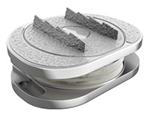
As it turns out, this Stenum Hospital is a participating hospital in Germanys Universal health care system and specializes in orthopedics. They do mostly hip and knee replacement, as well as spine fusions, and for over 10 years have been a leader in the development of the disc replacement procedure. Medical treatment of humans must consider the unexpected, here all this is included: postoperative complications, i.e. infections, thrombosis are taken care of by them - as part of the package deal. Patients are under their care for 1-2 preoperative days +/- 5 postoperative days with daily physiotherapy and daily rounds by Dr Zechel, plus, a 7 day out-patient stay at a Bremen Hotel. Dr Zechel and Dr Ritter-Lang have done 312 monosegment disc replacement and 78 bisegmental disc replacement using the SB Charite III disc replacement. Dr Ritter-Lang was trained and specialized in the spine department of the University Hospital Charite in Berlin - the hospital that developed the SB Charite I-III, together with LINK, the company that invented the implant. The level of care and detail given to each aspect of this procedure is astounding. The extreme care taken to avoid risk of damage to organs, nerves and arteries on the approach path, in addition to the careful and precise placement of the implant was impressive. The disc replacement team included Dr. Zechel, Dr Ritter-Lang and their team, in addition to a representative from Link, the implant manufacturer. I felt that no better team could be assembled anywhere in the world to insure my procedure went well. And it did!
I seriously doubt that any US doctors will ever get to this level, even after hundreds of surgeries, not to mention the hassles you will likely go through getting your doctor and insurance company to agree to do a disc replacement, before you are forced to suffer for years.
Our Room/pre-op
Our room had a wonderful view of the grounds, all the comforts of home, a phone with calling card available, although CNN was the only english channel on the TV. Very nice for a hospital! The next day they did x-rays, an EEG, blood work, etc..and we sat down with the doctor to discuss the procedure. They really take the time to answer any questions you have and make sure you understand what is going to happen.
The Procedure/Recovery
I awoke in the ICU, their version of a recovery room,
soon after surgery and was told all had gone well.
There was no pain to speak of, due to a nice morphine drip,
although I had a true sense that my disc pain was gone.
After a few hours the doctors asked me if I wanted to try and stand,
shocked and in a morphine stupor, I declined.
Some time later they informed me I needed to urinate, after unsuccessful efforts on my part they resigned to do a catheter. Looking back I would highly recommend taking their offer to stand, and walk to the toilet!
Anyway, 12 short hours later I was back in my room and feeling fine. They switched me over to a pump which I could control for the morphine and I quickly realized that the nausea and hot flashes I was feeling were a direct result of the morphine, a fact that seems obvious now, but when you are 12 hours post-op and on morphine these things are not so clear. I decided to only use the pump when the pain got bad, it never did. Now less than 18 hours post-op, I decided to take their offer and stand up. No problem! I walked with a walker at first, then asked why it was needed. They commented that I was on morphine and could get dizzy. When I told them I had not used it for several hours they were first shocked, then happy to let me walk unassisted. I took advantage of this breakthrough to walk to the toilet, and was quite happy to relive myself without the help of a catheter. From then on I was up every 4 hours walking around and morphine free, as well as mostly pain free. The only real pain was from the incision and some post catheter burning.
Over the next 3 days I walked more and more and had some physical therapy. I was really feeling fine, except for the annoying stitches, which dropped below my waist line and prevented me from wearing pants, or anything with a waist band. Several times Dad and I snuck out of the hospital to have a meal and a beer across the street at the pub. These events were met with great concern from the nurses upon our return, and we were soon refered to as the American tourists down the hall. On day 3 post-op I was done with being in a hospital, although my private room where my father and I enjoyed all the comforts of home was wonderful, it was still a hospital. We were released the next morning and moved to the Bremen Marriott.
I must make an important point here, not all recoveries are this fast! Your recovery will depend on factors like, age, how long you have been in pain, how much nerve and ligament damage is present, etc. Many have had similuar experiences, but I would not consider mine typical. You leave Stenum when you and the doctor agree you are ready. Most patients are getting up, spending most of the day up and about, by day 2-3, many are not.
The Vacation...week 2 of recovery!
We proceeded to shop and walk around Bremen like the true tourists we were, and by day 6 my father was having trouble keeping up with me. Bremen Germany is a wonderful city, with all the charm of San Francisco, a long history, and the Becks plant! The first day we walked across the bridge into town and shopped, checked out the market square and the historic buildings, I think we covered a mile or two.
The next day we ventured a little farther, to the waterfront and around the town. Set aside a day to explore the Schnoor shops, Lunch at John Benton is good, great place to people watch. If you cross the bridge (coming from the Park Hotel) and turn right (left after the Pigs coming from the Hilton) just before the pigs, you'll see, you will come to a cafe called Stecker, the only place in Germany we found eggs and bacon, great pastries!
I did have some soreness in my back as the muscles and facets adjusted to their new status, I was now 3/4 inch taller.
Castles and more!
On day 7 we set out on a driving tour of Germany, yeah, me driving. What a trip, many of Germany's castles are now hotels, we drove the autobahn in our Mercedes, stayed in castles, wondered through cute villages, all the way to the Alps and back in 5 days, a bit aggressive but it was divine.
This link will get you to the castle web site, http://www.german-castles.biz/
Landsberg was my favorite, the dining room is to die for.
Driving did cause more soreness after a couple of hours, so we stopped often and I soaked in a hot tub each night. (Please note, I now believe that driving, and certainly soaking in a tub, after just 7 days was a mistake and is not recommended)
Day 14 post-op, I was on a plane for home, no pain other than a little muscle soreness from all the travel activity.
One important point I must clarify is that when I left for Germany I was a slim and fit 46 year old, still working full time and although not athletic did exercise regularly. I also prepared for this ordeal by dropping more weight and working out with a focus on the leg and abdominal muscles which would be so important post-op. I probably represent close to the best case possible for quick recovery. Any factors like excessive weight or lack of muscle strength will lengthen your recover time. It is also important to consider getting this done early on to avoid complications and even disqualification for the procedure. Factors like age, nerve damage, prior surgeries, and severe progression of the degeneration can be contra-indications and prevent you from getting an implant. Don't wait!
In Conclusion
After a long and successful ordeal I find myself, for the most part, pain free. I still get sore with activity, and have an annoying pulling feeling down to my toes, although the doctors assure this will pass with time. I am so glad that I persisted in my pursuit of disc replacement. So glad that I didn't fork over the $60K to some US doctor who had only done a handful of these procedures. As it turned out, since I was released in only 4 days my bill was adjusted and the whole thing cost less than $22K (and this became the price for later Americans who followed, your welcome! now 23K Euro, inflation!).
I feel very confidant that I got the best care available in the world, and that most Americans have no idea this level of expertise exists outside the US, or that it is available to them. I will do everything I can to prevent the thousands of unnecessary disc fusions done on innocent Americans each year and to educate back pain sufferers on this breakthrough. Whether they go to Germany, to receive the quality care I got, or work through the insurance process to take their chances with the US doctors, this will change how degenerated disc disease is treated forever.
While I was still in Germany the chief surgeon and the international administrator asked me to have dinner at the doctor’s house. At this dinner they told me they would pay me if I sent other Americans to them. They explained that this was an exclusive agreement and from this point forward all patients arriving from North America would be considered from my efforts.
I went home thinking that maybe I could find a few people and get some of my cost of surgery back.
I was on a chat group, this was 2004, before social media, and I posted an update when I returned home.
I also typed up my trip notes above and created a $49 Godaddy website with the story and the admin in Germanys email address.
On day about 6 months after my return I got an email from Germany asking me for my wire transfer info. Someone had come for surgery!
They sent me $3000!
I was so excited and I told a friend about my payment. He suggested I do a Google Ads account. I had no idea what that was, after all Google was pretty new back then. I set it up and planned to spend the entire three thousand over the next few months.
A few months later, in November 2004 we had three surgeries. In January we had 9! Off it went!
Now in 2025 we have done several thousand surgeries, about 125 a year for 22 years.
This is not just a story of success but a story of persistence and commitment.
I still work everyday to educate people about Disc Replacement and promote Stenum Hospital and my surgeon Dr. Karsten Ritter-Lang.
Karsten and I have become good friends and business partners and have remained loyal to each other through many situations that have put or enterprise at risk.
Over the past 20 years I have helped many thousands of people understand what Disc Replacement Surgery is and have learned a lot about marketing, Google Ads, SEO, and can create websites that easily come up in search results and generate leads.
I truly consider this enterprise as more than just a job or a career.
When I think about my legacy of course the work I have done to “pay it forward” regarding my disc replacement surgery and my contribution to society this represents is a big part of it. However, deep down, it’s my family and the people I love that are my true legacy.
“After years of suffering, I avoided spinal fusion surgery, had Disc Replacement Surgery, went to Dr. Ritter-Lang and had a wonderful result.”
"Dr. Ritter-Lang gave me a solution that I was not being offered by my doctors in the US"