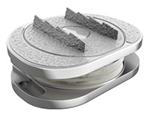
The ANA.NOVA hip cup (specifically the ANA.NOVA® Hybrid Cup and ANA.NOVA® Alpha Cup) is a type of cementless press-fit acetabular implant used in total hip arthroplasty. Developed by ImplanTec GmbH and sometimes marketed by other companies like ARTIQO Endoprothetik, it is designed to provide biomechanical stability and allow for early weight-bearing after surgery, with studies investigating its migration patterns and early clinical outcomes.
Key Features & Purpose:
- Press-Fit Design: The cup is press-fitted into the patient’s bone without the need for cement, relying on its innovative design to achieve stable fixation and promote osteointegration.
- Biomechanical Characteristics: It was designed with superior biomechanical features to ensure stability and function after the procedure.
- Minimally Invasive Surgery: The design aims to facilitate bone-saving and minimally invasive surgical techniques, like the one mentioned by ARTIQO, allowing for immediate full weight-bearing.
- Hybrid Design: The ANA.NOVA Hybrid Cup combines the functional aspects of both a press-fit and a screw cup design.
Clinical Application:
- Total Hip Arthroplasty (THA): These cups are used in patients requiring hip replacement due to conditions like osteoarthritis or avascular necrosis.
- Migration Studies: Studies using the EBRA (Einzel Bild Röntgen Analyse)method have been conducted to track the implant’s migration and stability in the first few years post-surgery.
- Associated Stems: The ANA.NOVA cup is often used in conjunction with short, cementless femoral stems, such as the ANA.NOVA proxy hip stem,which also promotes osteointegration.
Manufacturers:
- The ANA.NOVA products are developed by ImplanTec GmbH and can also be found from ARTIQO Endoprothetik.
The Best of Both Worlds: The Advantages of a Cementless Hybrid Hip Cup
Hip replacement surgery has evolved dramatically over the past few decades, driven by a quest for longer-lasting implants and better patient outcomes. A key area of innovation has been the method of fixation, or how the implant is secured to the bone. While cemented and fully cementless implants each have their own merits, a “hybrid” approach—specifically, a cementless cup combined with a cemented stem—has emerged as a compelling option, offering a unique set of advantages.
Understanding the “Hybrid” Concept
In a traditional hip replacement, both the femoral stem (which goes into the thigh bone) and the acetabular cup (which goes into the pelvis) are either cemented or uncemented. A hybrid hip replacement, however, strategically combines these two fixation methods. The most common configuration is a cemented femoral stem and a cementless acetabular cup. This is sometimes referred to as a “reverse hybrid,” though the terminology can vary.
The logic behind this hybrid approach is to leverage the strengths of each fixation method while mitigating their weaknesses, particularly in the hip socket.
The Advantages of a Cementless Cup
The use of a cementless cup in this hybrid system offers several distinct benefits:
- Promotes Natural Bone Ingrowth: The primary advantage of a cementless cup is its ability to create a biological bond with the patient’s bone. The outer surface of the cup is porous or specially coated (often with a material like hydroxyapatite) to encourage the surrounding bone to grow directly onto and into the implant. This natural bone integration leads to a very strong, long-term fixation that can be more durable than cement over time, especially for younger patients with good bone quality.
- Facilitates Use of Modern Bearing Surfaces: The cementless cup provides a stable, modular shell for a variety of inner liners. This allows surgeons to utilize the latest and most advanced bearing surfaces, such as highly cross-linked polyethylene or ceramic liners. These modern materials are designed to have extremely low wear rates, which is a major factor in the long-term success of a hip replacement. The strong, biological fixation of the cementless cup is an ideal platform for these high-performance materials.
- Reduces Risk of Aseptic Loosening: For decades, a significant concern with cemented cups has been aseptic loosening, where the cement bond breaks down over time due to stress and micromotion. This can lead to pain and eventually require revision surgery. The biological fixation of a cementless cup minimizes this risk, as the bone and implant become one solid, integrated unit. Studies have shown that cementless acetabular components have a lower risk of revision due to aseptic loosening compared to their cemented counterparts.
- Provides Surgeon Flexibility: The hybrid approach gives the surgeon the flexibility to choose the best fixation method for each component based on the patient’s individual anatomy and bone quality. For example, an older patient with poor bone quality in the femur might benefit from the immediate, solid fixation of a cemented stem, while a healthy pelvis can be a perfect candidate for a cementless cup.
When is a Cementless Hybrid Hip Cup the Right Choice?
The hybrid approach is not a one-size-fits-all solution, but it is a highly effective option for a wide range of patients. It is particularly well-suited for: - Younger, active patients who are expected to outlive their first implant and may require a revision in the future. The preserved bone stock and the durability of the cementless cup make future procedures less complex.
- Patients with good pelvic bone quality but who may have weaker femoral bone due to age or other conditions.
- Surgeons who are experienced and confident in the press-fit or screw fixation techniques required for a cementless cup.
In conclusion, the cementless hybrid hip replacement represents a sophisticated and balanced approach to total hip arthroplasty. By combining the immediate stability of a cemented stem with the long-term biological fixation of a cementless cup, it offers a durable, reliable, and highly successful solution for a broad spectrum of patients seeking to regain mobility and an active life.
Learn more about Minimally Invasive Hip Replacement with Bone-Sparing Short-Stem Devices